When should you hire a DevOps agency?
A DevOps agency becomes useful when infrastructure work consumes a significant part of the product team’s time or production still depends on procedures that are difficult to reproduce.
Common situations include manual deployments, unclear environments, historical access, insufficient monitoring, untested backups, infrastructure growing without shared standards, or the departure of a key person.
Koragence can take on a focused workstream or provide recurring capacity depending on the situation.
What signs show that your DevOps needs structure?
These signals connect delivery, operations, and ownership. They indicate the type of assessment to perform before choosing a tool or operating model.
Deployments remain stressful
A production release involves several people, depends on local steps, or has an uncertain rollback.
One person knows the infrastructure
Access, pipelines, and procedures still depend on a CTO, lead developer, freelancer, or former provider.
Incidents take too long to understand
The team lacks logs, metrics, alerts, or runbooks that connect a degradation to its cause quickly.
Backups exist without tested restoration
Having a backup does not demonstrate the ability to restore the service to production.
Environments drift apart
Staging, testing, and production use configurations that differ too much for validation to remain representative.
Cloud spend grows without clarity
The team knows the total bill without enough information to understand the main cost drivers. The AWS cost optimization page covers this scope.
What our DevOps agency can handle
Scope depends on the product, environments, and expected level of responsibility. Each workstream is connected to a readable operational outcome.
CI/CD and deployment automation
Koragence designs or takes over build, test, packaging, validation, deployment, and rollback pipelines. We work with GitHub Actions, GitLab CI, Azure DevOps, or systems that already fit the team. The pipeline should identify the built version, executed checks, production approval, and path back to a stable state. See CI/CD setup.
Cloud architecture
Koragence works across AWS, Azure, OVHcloud, and other platforms already used by clients. Work can cover architecture, networking, compute, storage, databases, backups, secrets, environments, resilience, and capacity. The platform is chosen around the product need.
AWS
When a project mainly relies on AWS, Koragence can take over or structure CI/CD, infrastructure, observability, backups, and operations around the services actually used. See the AWS DevOps provider.
Azure
Microsoft environments can include identity, networking, compute, managed services, pipelines, and Azure governance according to the information system. Scope depends on the services actually used and team ownership.
OVHcloud
OVHcloud can fit European hosting, compute, networking, or Cloud infrastructure needs for some projects. The choice remains tied to cost, location, operations, and resilience constraints.
Docker and containers
Containerization can make environments more consistent and deployments more reproducible when the application fits. The choice remains proportional to system complexity.
Kubernetes
Kubernetes becomes relevant when an organization has enough workloads, scheduling, deployment, and scaling needs to justify its complexity. Koragence can work on Kubernetes environments when required, while choosing a simpler architecture when managed services already cover the need.
Infrastructure as Code
Terraform or other IaC approaches can version part of the infrastructure, review changes, and reduce manual operations. The level of versioning should fit the actual environment.
Monitoring and observability
Koragence sets up metrics, logs, errors, alerts, and dashboards that make production understandable. Monitoring reflects critical service journeys, not only CPU and memory. See the monitoring, alerts, and backups page.
Backups and restoration
Backups are scoped around data, frequency, retention, and recovery objectives. Restoration tests verify that data can actually be put back into service.
Incident recovery
Koragence structures ownership, runbooks, rollback, restoration, failover, and communication so the team has a framework before the next major incident. See incident recovery.
High availability
Redundancy should match the real cost of an interruption. Multi-zone, multi-region, load balancing, replication, and failover add resilience, cost, and complexity. See high-availability architecture.
Secrets and production access
Koragence structures identities, permissions, service accounts, secrets, variables, and production access so every responsibility remains understandable and revocable. See the dedicated page on secrets and roles.
Cloud cost optimization
Infrastructure decisions directly affect service cost. Koragence can identify idle resources, overprovisioning, unnecessary environments, and costly architectures, with a link to AWS cost optimization when AWS is the main scope.
Operational security
Pipelines, secrets, identities, environments, and infrastructure include controls consistent with the risk level. A Cloud security audit is a distinct scope when IAM, network exposure, data, or compromise paths must be assessed.
One-off project or recurring DevOps capacity?
A one-off engagement fits when a precise objective is identifiable: build a pipeline, recover access, set up monitoring, or prepare restoration.
Recurring capacity becomes relevant when Cloud changes, releases, incidents, cost, and operations create a continuous backlog. Koragence can then work as an outsourced DevOps team with a cadence aligned to workload.
When should you start with a DevOps audit?
A DevOps audit is relevant when an organization knows delivery or infrastructure has problems but lacks a precise enough view to choose the first workstream.
The audit reviews CI/CD, environments, Infrastructure as Code, observability, incidents, organization, and metrics to produce a roadmap. It remains distinct from implementing the fixes.
How do you take over infrastructure managed by another provider?
The transition starts by recovering the control chain: Cloud accounts, DNS, repositories, pipelines, secrets, monitoring, backups, IaC, and procedures. Access is recovered through dedicated accounts, MFA, and scoped permissions.
DevOps takeover is complete when the new team can change, deploy, observe, and restore the system without relying on the former provider.
DevOps for growing SaaS products
SaaS products add specific constraints: multi tenancy, processing queues, webhooks, tenant observability, capacity planning, enterprise customers, and cost per tier. The DevOps for SaaS page covers this depth.
DevOps and application maintenance: how should scope be split?
Application maintenance mainly covers code, bugs, dependencies, and small changes. DevOps covers environments, deployments, infrastructure, observability, backups, and recovery.
Both models can operate together when the product and its infrastructure are closely connected.
Projects operated over time
Public case studies show systems used over time, with monitoring, history, access, availability, and evolution. Metrics shown in the cards remain attributed to each project.
Onctuo illustrates a supervision platform and Good is Merch a business platform maintained in production. These references do not constitute a generic availability promise for every DevOps engagement.
Why choose Koragence as a DevOps agency in Paris?
Koragence coordinates development, architecture, infrastructure, cybersecurity, and maintenance when the product requires it. Scope is chosen around risk and production reality.
A team covering build and run
Development, architecture, infrastructure, cybersecurity, and maintenance can progress within one model when the product connects them.
Pragmatic expertise
Kubernetes, multi-region architecture, or Infrastructure as Code are used when their operational value is clear. A simpler architecture remains preferred when it already covers the need.
Transparent follow-up
The client space provides visibility into the roadmap, tasks, current stage, documents, meeting notes, and feedback. Important decisions remain dated and accessible within the project framework.
A take-over-ready foundation
Repositories, client-owned accounts, IaC, documentation, runbooks, and revocable access should remain readable. Structural Cloud accounts remain under the client company’s control.
A Paris base with national reach
Paris supports workshops when they add real value. The hybrid model supports companies in France and internationally.
A network with represented schools
Schools represented in the Koragence network include EPITA, EPITECH, ESSEC Business School, HEC Paris, École Polytechnique, and CentraleSupélec. They are not DevOps certifications.
How does Koragence deliver DevOps engagements?
The method connects existing systems, risks, changes, and continuity. It adapts to one-off projects and recurring capacity.
We start by understanding the current setup and its applications, environments, pipelines, access, backups, monitoring, and business constraints. We then define priority risks, stabilize critical access and procedures, progressively industrialize CI/CD, IaC, and observability, measure the effects, document decisions, and evolve the setup through recurring DevOps capacity, maintenance, or focused support.
How should DevOps improvement be measured?
The five DORA metrics, when available and defined consistently, provide a delivery reference: change lead time, deployment frequency, failed deployment recovery time, change fail rate, and deployment rework rate. Methods are documented by DORA.
The local page remains focused on intervention and continuity. A DevOps audit goes deeper into maturity, data, and roadmap.
How much does a DevOps agency in Paris cost?
Budget depends on criticality, number of environments, availability target, support window, and takeover scope. The Paris location does not create an artificial surcharge: technical scope and service level determine most of the budget.
The current DevOps hub documents initial takeover as a workstream generally ranging from €2,000 to €8,000 excluding VAT depending on the existing setup. Recurring operations, on-call coverage, and critical support are quoted separately according to the contractual scope.
DevOps agency or freelancer: which model fits?
A DevOps freelancer can be highly effective when the scope matches a clear skill and the company already has governance, procedures, and continuity coverage.
An agency becomes more relevant when several skills must be coordinated, service coverage must survive individual unavailability, or Cloud, CI/CD, security, observability, and maintenance must progress together.
DevOps agency or larger IT services company: what is the difference?
A larger IT services company can efficiently address staffing or assemble large teams. Koragence focuses on scopes that need ownership: existing-system takeover, foundation setup, delivery improvement, run security, or recurring support.
On-call, SLAs, and availability: what can you offer?
On-call coverage can be structured for certain critical services according to scope, hours, channels, response time, and ownership defined in the contract. 24/7 coverage remains strictly tied to a specific service and contractual commitment.
An availability target must connect to architecture, redundancy, monitoring, backups, failover, and the operating level actually funded. Koragence can design a setup for a high target when the business need justifies it.
Access, ownership, and reversibility
During an assessment, read-only access is preferred. During delivery, dedicated accounts, MFA, scoped permissions, no passwords in clear text, and no shared root keys structure operational security.
Structural Cloud accounts should remain under the client company’s control. If the agency changes, repositories, client-owned accounts, IaC, documentation, runbooks, secrets in an appropriate vault, and revocable access should support a readable transition.
Examples of situations we handle
CI/CD redesign after several release incidents. Takeover of AWS managed by a former provider. Monitoring and backups before a scale-up. DevOps structure for a growing SaaS. Separation of staging and production. Control of secrets and access. Preparation of a critical platform for a higher availability target. AWS cost reduction after a growth phase.
These examples describe scoping situations, not additional client references.
When should you hire a DevOps engineer internally?
Hiring becomes relevant when the company has stable daily workload for a lasting role. An agency remains useful during a takeover, transformation, scale-up, or when several skills are needed part time.
Koragence can also work with an internal DevOps team and progressively hand over procedures, access, pipelines, runbooks, and ownership.



 Onctuo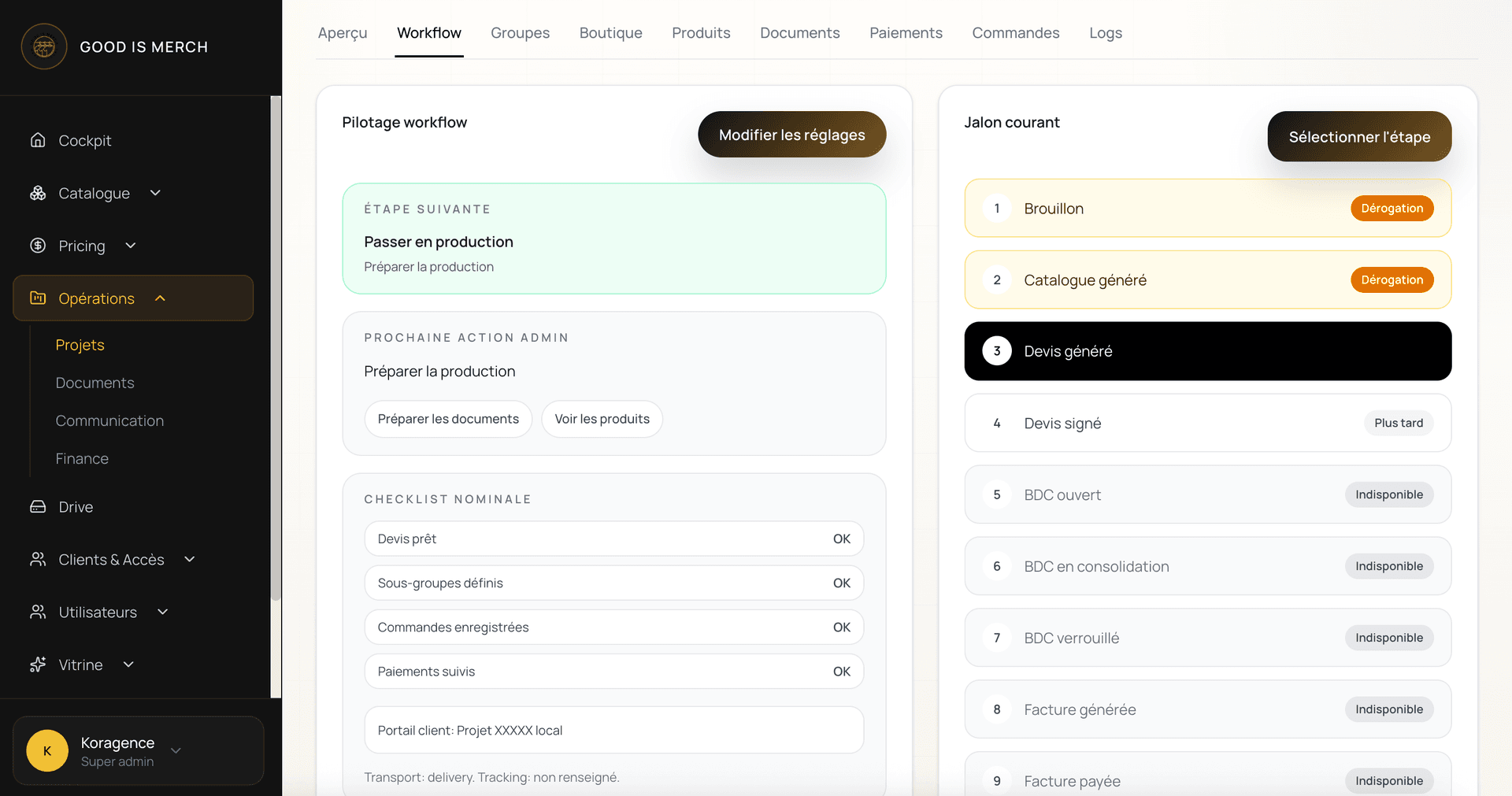
 Good is Merch