
What is industrial energy isolation?
Energy isolation is a procedure that places equipment in a safe state before work by preventing hazardous energy from appearing or reappearing. In France, INRS guidance describes isolation as protection against the persistence, unexpected appearance, or reappearance of hazardous energy or fluids.
Relevant sources may be electrical, mechanical, hydraulic, pneumatic, thermal, chemical, gravitational, or related to pressurized fluids. The software should therefore do more than display a checklist: it should connect the equipment, the energy sources, and the isolation points that must be secured before work.
The figures shown below the cards are Koragence experience benchmarks from connected workflows; they are not results from a LOTO project specifically.
Electrical energy
Mechanical energy
Hydraulic or pneumatic pressure
Heat, chemicals, or gravity
LOTO and energy isolation: what is the difference?
LOTO means Lockout/Tagout. The principle is close to industrial energy isolation in France: isolate hazardous energy sources, prevent unintended re-energization, and clearly identify the prohibition.
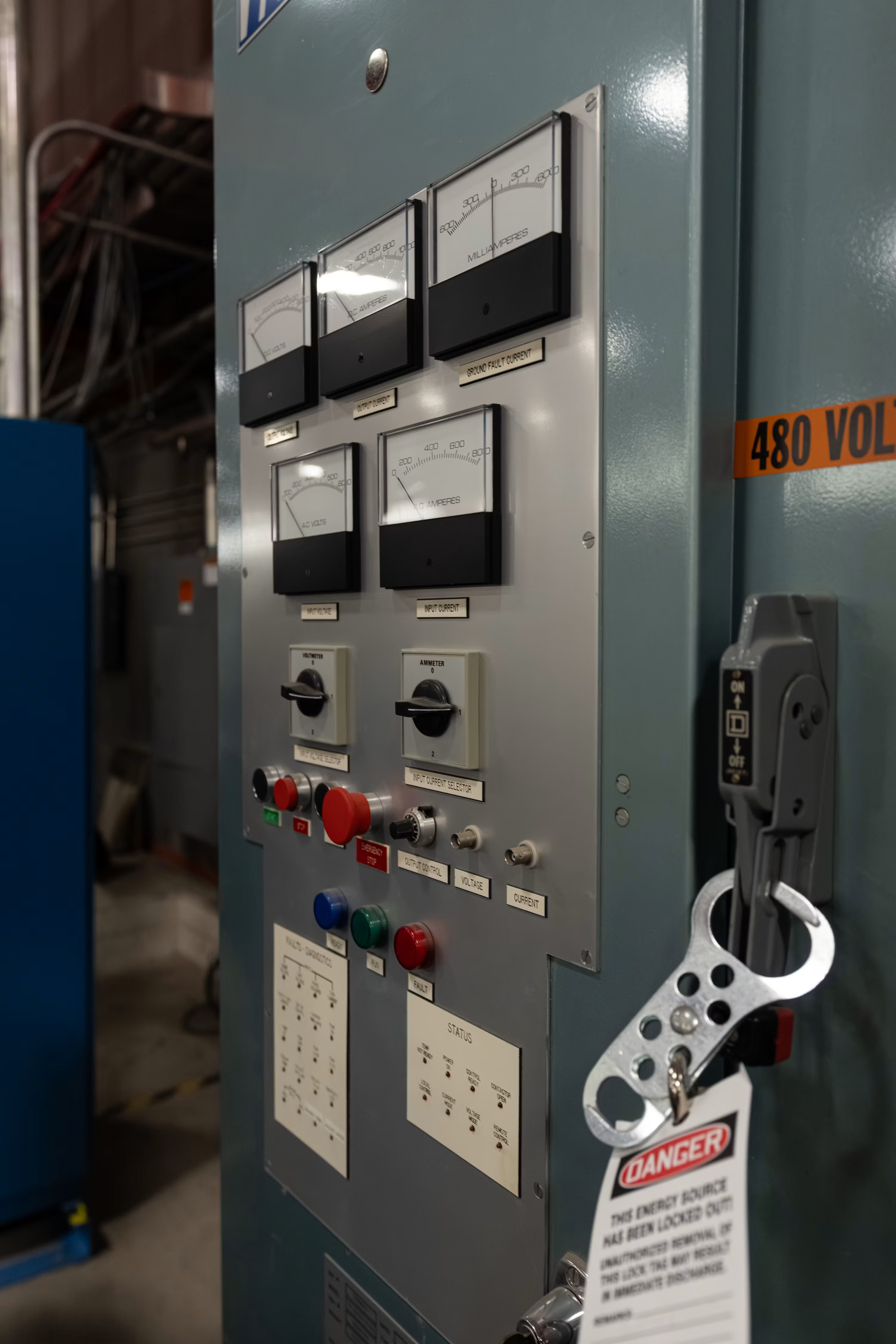
Under the United States OSHA 1910.147 standard, lockout means physically locking an energy-isolating device and tagout means applying a warning tag. This is a US reference for hazardous-energy control; it does not replace the rules applicable to a site in another jurisdiction.
The primary English terminology is therefore lockout/tagout and energy isolation, while the French terms consignation / déconsignation remain useful when documenting French site procedures or multilingual operations.
What workflow should an isolation procedure follow?
The workflow should make every gate visible and block the intervention until mandatory steps are validated. The software can guide people, retain evidence, and flag deviations, but it does not replace physical devices or the competence of the people carrying out the work.
Work request → equipment identification → energy identification → shutdown → separation / isolation → lockout → dissipation of residual energy → verification → authorization to work → maintenance → release → return to service.
How should energy sources and isolation points be managed?
Each asset can have an isolation record covering energy sources, the location of each isolation point, device type, photos, operation order, required lock or device, verification step, and residual risks.
For example, a press named P-204 can link its electrical supply to disconnect Q17, hydraulic pressure to valve V12, and gravitational energy to mechanical block B04. This prevents the procedure from being rebuilt for every intervention.
Specialized solutions such as Brady LINK360 already use visual procedures connected to assets and isolation points. Custom software becomes relevant when those procedures must also connect to a CMMS, work permits, Management of Change, or site-specific rules across several locations.
Press P-204 → disconnect Q17 → electrical energy
Press P-204 → valve V12 → hydraulic pressure
Press P-204 → block B04 → gravitational energy
Why must residual energy be addressed?
Turning off the main supply is not always enough. A machine may retain hydraulic pressure or compressed air, a charge in a capacitor, elevated parts, heat, a tensioned spring, or pressurized fluid.
The procedure must provide for the dissipation, restraint, or control of those sources before work begins. OSHA 1910.147 requires stored or residual energy to be relieved, disconnected, restrained, or otherwise rendered safe before servicing; that reference must be understood within its US regulatory framework.
How can you verify that isolation is effective?
Verification that energy is absent or properly isolated must take place before work begins. For electrical isolation, INRS guidance includes separation, locking, identification, absence-of-voltage verification, and, where required, earthing and short-circuiting.
The software should record what was verified, by whom, when, and with what result. A digital validation must never be mistaken for a physical measurement if the person has not performed the required check with the appropriate equipment.
How should several workers be managed on one machine?
One intervention may involve mechanical maintenance, an electrician, an automation specialist, and an external contractor. The machine must not be returned to service simply because the first person has finished their work.
The system can track each person and confirmation: isolation active → worker A finished → worker B finished → worker C still present. Final release remains blocked until the defined conditions are met.
For physical devices, this record can be associated with individual locks, hasps, or lock boxes according to site procedures. The application organizes evidence; it does not create the physical protection.
How should the release and return to service be managed?
Return to service should be structured just like isolation. It can verify that the work is complete, tools have been removed, guards are back in place, people are outside the danger zone, and locks are removed according to the procedure.
Energy can then be restored progressively, the equipment tested, and affected users informed. INRS describes release from isolation as the measures used to return previously isolated equipment to operation while protecting people and equipment.
How can you prevent an obsolete LOTO procedure?
A procedure can become wrong when a machine changes: a new valve may be added while the isolation record is never reviewed. The software should therefore manage procedure versions, last review date, affected asset, and the change that triggered the update.
A MOC, Management of Change, that modifies an asset’s energy sources or isolation points can automatically trigger a review of its LOTO procedure. Connecting the two workflows prevents the change from being closed while impacted safety documentation remains untreated.
How can QR codes or NFC be used in the field?
A QR code or NFC tag placed on a machine can open the correct procedure, isolation-point photos, energy list, current isolation status, and active work orders. This reduces the risk of selecting the wrong record among nearby assets.
A QR code remains a way to access information, not proof that the equipment is physically safe. The worker must still follow the procedure and perform the required checks.
Should a field application support offline work?
Work may take place in a basement, a metal structure, an isolated workshop, or a site with poor network coverage. A field application can therefore keep the procedure, photos, assets, and required steps locally.
Evidence and statuses are synchronized when connectivity returns. For critical actions, the project must define exactly what can be viewed offline, what can be prepared, and what requires online synchronization or approval.
How should LOTO connect to a CMMS?
A CMMS, Computerized Maintenance Management System, manages the maintenance intervention and work order. LOTO software manages the energy isolation required before that work. A work order such as `WO-2841` for pump P-204 can therefore trigger the correct isolation procedure for that asset.
Work order → asset → LOTO procedure → isolation → authorized work → release → work order closed. This connection prevents safety from being tracked in a separate tool with no link to the actual maintenance intervention.
What is the difference between LOTO and a work permit?
LOTO answers: how are hazardous energy sources isolated for this asset? A work permit answers a broader question: can this work be performed in this area and under these conditions?
A work permit can therefore require LOTO to be completed before the permit becomes active. The processes are connected but distinct: LOTO controls energy, while the permit governs the complete intervention, its environment, and its conditions.
How should roles and responsibilities be recorded?
INRS distinguishes, among other roles, the person responsible for isolation and the person responsible for the operation. The first manages isolation and release; the second leads the work and authorizes its start according to the organization in place.
The software can manage the requester, isolation owner, work owner, workers, supervisor, and external contractor. Permissions should match the responsibilities defined by the company, the required qualifications, and site rules.
Which KPIs should be tracked for isolation procedures?
Steering can remain simple: active isolations, time between isolation and return to service, procedures due for review, missing steps or checks, isolations by asset, and incidents or near misses linked to a procedure.
The goal is not to reduce duration artificially. A fast but incomplete isolation is not good performance. Metrics should instead reveal delays, obsolete procedures, and deviations that require action.
Brady LINK360 or custom LOTO software?
Brady LINK360 provides a solution to create, maintain, distribute, and review LOTO procedures, including on smartphones and tablets. A standard product makes sense when the core need is procedures, documentation, assets, audits, and field distribution.
Custom software becomes more relevant when isolation must be deeply connected to the CMMS, work permits, MOC, qualifications, contractors, specific assets, or multi-site workflows. A fit-gap, meaning a comparison between actual needs and standard coverage, should come before development.
How much does custom LOTO software cost?
Cost depends on the number of assets and procedures, mobile capabilities, offline mode, QR codes or NFC tags, multi-worker workflows, and integrations with the CMMS, work permits, or MOC.
A digital procedure library is very different from a field system connected to several industrial sites. Scoping should also separate procedure migration, rule design, development, field validation, and ongoing operations. A generic average is not meaningful without that scope.


