How do we structure business data?
We design a coherent data model around your core business objects and their relationships. Customers can own multiple cases, cases multiple documents, and orders several lines, approvals, and events. PostgreSQL or an equivalent relational database can preserve this structure with constraints, histories, and explicit relationships.
We also define identifiers, uniqueness rules, histories, archiving, and data quality controls to support reliable reporting and easier-to-maintain integrations.
How do we manage roles and permissions?
We can separate employees, managers, administrators, clients, and partners with precise permissions for viewing, creating, editing, approving, exporting, and administering business data.
Authentication can use SSO and MFA through Microsoft Entra ID, Google Workspace, Okta, or a dedicated identity system. Sensitive actions can be logged so decisions made in the software remain clear and traceable.
How do we automate business workflows?
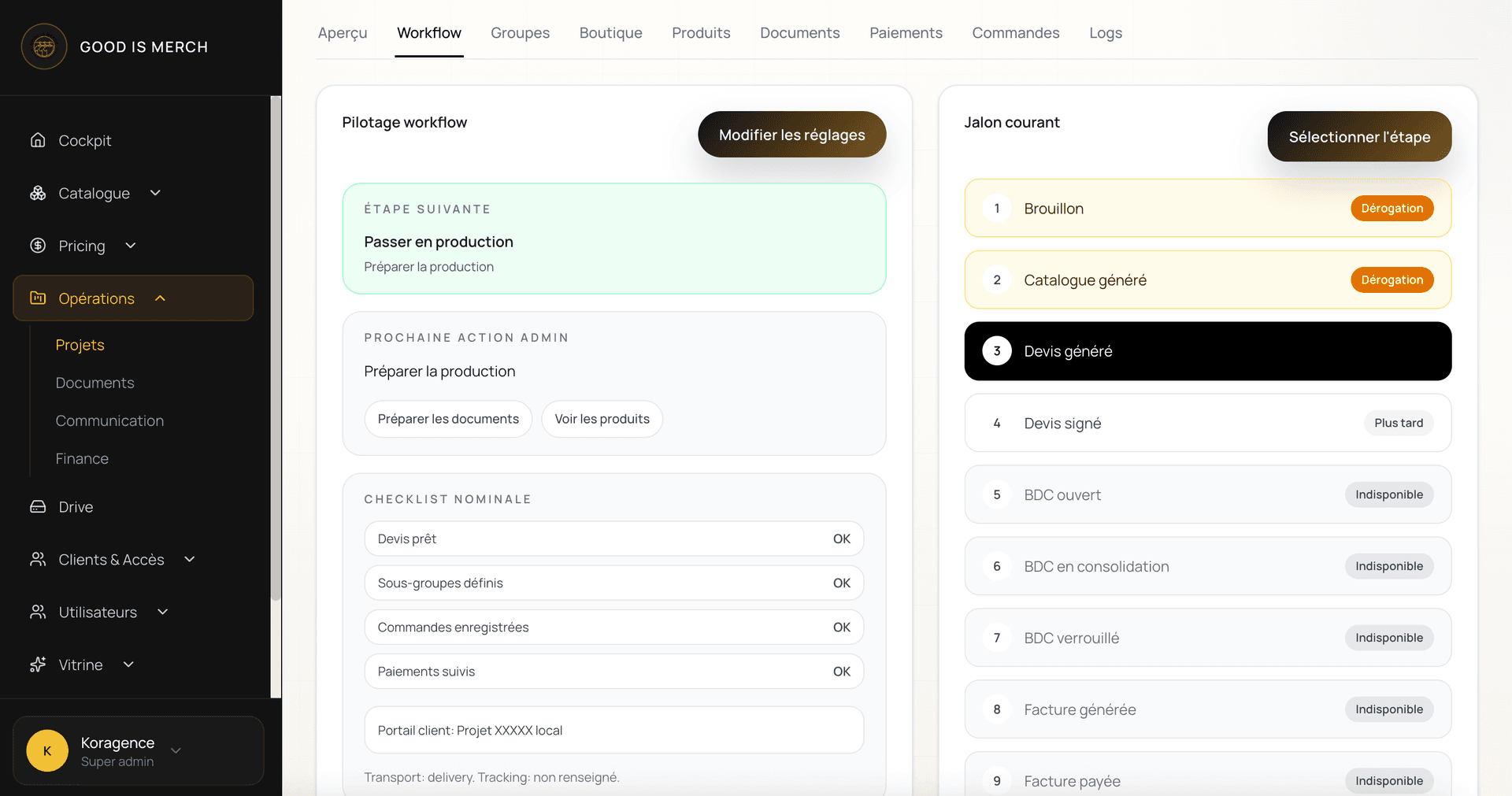
Business events can automatically trigger actions: status changes, approvals, deadlines, incoming data, or document creation. A rule can send a notification, create a task, generate a document, call an API, or transfer information to another system.
Long-running operations can use workers, queues, and asynchronous jobs so activity continues without blocking users.
How do we connect business software to existing systems?
We integrate the systems that remain part of your operations: ERP, CRM, accounting, document management, payments, e-signature, BI, identity platforms, and industry software. Each integration defines the exchanged data, authoritative system, trigger, and error-handling process.
REST APIs, webhooks, structured imports, and synchronized jobs can coexist according to each tool’s capabilities. Exchange logs then help identify errors and retry the affected flows.
Which dashboards and KPIs can we build?
Reporting can use operational data directly: active volumes, processing times, blocked cases, orders, approval rates, team workload, incidents, margins, or business-specific indicators.
Views can be adapted to each role so leadership sees overall performance while operational teams focus on actions, deadlines, and exceptions.
How do we manage business documents?
Software can generate, classify, and attach quotes, contracts, invoices, purchase orders, reports, and other files to the correct business case. We can manage templates, versions, metadata, approvals, e-signatures, and archiving according to the workflow.
Documents can be stored in object storage or an existing document platform, while the software keeps their references, permissions, and links to business data.
How do we migrate existing data?
We map data sources such as spreadsheets, CSV files, legacy databases, CRM, ERP, and existing applications. Migration defines field mapping, transformations, identifiers, duplicates, missing values, and relevant history.
Test imports validate volumes, consistency, and transformation rules before final migration. Detected gaps remain visible so data requiring a business decision can be handled.
Standard software or custom business software?
Standard software is faster to deploy when your organisation can follow its operating model: you benefit from a vendor, available capabilities, and a more predictable initial investment. In return, you must accept its objects, workflows, and integrations; gaps may require configuration, workarounds, or additional tools.
Custom development becomes relevant when your business objects, rules, approvals, or integrations are central to your way of working and an existing product imposes too many compromises. You gain a solution adapted to your operations, with a scope to define and a long-term investment to manage. We can also keep a standard ERP or CRM and develop only the specific business layer required around it.
How do we secure business software?
We can implement SSO, MFA, granular permissions, audit logging, and environment separation. Infrastructure can add secret management, encryption, WAF protection, firewalls, VPN access, or private networking depending on data sensitivity.
Backups, restoration procedures, logs, and alerting also support security by giving teams the ability to detect and handle incidents.
How do we operate and maintain business software?
We can implement CI/CD, separated environments, error monitoring, metrics, centralized logs, and backups. Sentry, Grafana, or Cloud monitoring services can expose errors, performance, and availability.
Ongoing maintenance can then cover fixes, upgrades, security, performance optimization, and functional evolution.
What drives the cost of custom business software?
Cost is mainly driven by the number of workflows, roles, business rules, integrations, documents, and data migrations. Advanced permissions, approval workflows, signatures, payments, automation, and reporting also add defined technical scope.
The quality of existing data, documentation of business rules, and API availability directly affect scoping and integration work.



 Good is Merch

 Onctuo