Gather and formalize business needs
Users often describe needs through the daily difficulties they face. They may explain that an operation requires several Excel files, that information must be entered in three systems, or that a task takes too long without knowing which IT solution should be built.
Business analysis turns these situations into functional needs that technical teams can understand and implement.
We speak with the relevant users, analyze existing processes, and identify the data, business rules, roles, and steps that must be covered.
This formalization keeps the business need as the reference throughout the project, including when several technical options are considered.
Map existing processes and tools
New software is rarely introduced into an empty environment.
We analyze the applications already in use, the data they contain, existing exchanges, and operations still performed manually.
This map shows where the new project actually fits in the information system and identifies dependencies that must be considered.
A CRM project may need exchanges with the ERP, accounting, website, and marketing tools. A new business application may depend on a legacy database or several existing reference systems.
These points are included early enough to avoid them appearing as unexpected additional work during delivery.
Write the IT specification
Koragence can write the functional and technical specification used to consult software vendors, integrators, or development companies.
The document describes the project context, objectives, users, expected functions, data, required interfaces, operating constraints, and acceptance conditions.
The level of detail depends on the consultation. Some projects need highly detailed functional specifications, while others should leave providers more freedom in how they meet the need.
We aim to produce a document precise enough to make proposals comparable without unnecessarily locking the solution before speaking with the companies being consulted.
Define non functional requirements
Functional requirements alone do not always define an IT project properly.
We can include requirements for security, availability, performance, backups, traceability, access management, hosting, reversibility, and maintenance.
These points directly affect the proposed architecture and project budget.
When these expectations are not stated before consultation, two providers may propose functionally similar solutions based on very different service levels.
Business analysis makes these expectations explicit before offers are compared.
Prepare the provider consultation
Once the need is sufficiently defined, we can prepare the consultation of companies able to deliver the project.
We structure the information so every provider has the same understanding of the context, scope, and constraints.
We can also organize discussions during the consultation so technical and functional questions receive a shared answer and any clarifications are properly documented.
The aim is to obtain genuinely comparable proposals rather than several quotes based on different interpretations of the project.
Compare proposals on a common basis
Price alone is not enough to compare two IT proposals properly.
We analyze understanding of the need, the actual included scope, assumptions, proposed architecture, project organization, timelines, maintenance terms, and recurring costs.
A cheaper proposal may, for example, exclude data migration, acceptance, certain integrations, or operations after go live.
We can build a common evaluation grid to identify these differences before selecting the provider.
Follow up questions and presentations then help resolve remaining ambiguities before the contract is signed.
Support the choice of software or vendor
Business analysis can also help when the project does not necessarily require custom development.
We can support the comparison between packaged software, SaaS, ERP, CRM, and custom development according to the processes and constraints involved.
The analysis covers functional fit, configuration options, integrations, data migration, operating costs, and the solution’s ability to evolve with the organization.
The aim is to distinguish native features from those requiring customization, extension, or a process change.
Oversee the project on the client side
Once the provider is selected, business analysis represents the client side during delivery.
We track scope, deadlines, open topics, dependencies, and decisions requiring a trade off.
Status reviews check that delivery remains aligned with the defined need and that changes are identified before affecting budget or schedule.
We prepare materials for project committees and keep decision records so important trade offs do not rely only on informal exchanges.
Coordinate business and technical teams
A key part of business analysis is facilitating exchanges between people who do not use the same vocabulary.
Business teams describe processes, constraints, and objectives, while developers, integrators, and vendors translate them into technical components.
We can prepare trade offs, rephrase questions, and check that the business consequences of a technical choice are understood by the relevant users.
Conversely, we explain technical or budget constraints to business teams when they affect how a feature should be delivered.
This coordination limits misunderstandings that often arise when a technical provider must interpret poorly formalized needs directly.
Track scope and change requests
Projects naturally evolve during delivery, but each new request can affect budget, timelines, and other features.
We therefore distinguish corrections needed to meet the initial scope from new requests that represent a change.
When a significant change appears, we analyze its consequences with the provider before adding it to the project.
This keeps trade offs clear and prevents a series of small changes from gradually altering the project without measuring their total cost.
Track schedule, budget, and risks
Business analysis follow up compares actual progress with the commitments made at the start.
We can track milestones, deliverables, dependencies, pending decisions, and risks that may affect the go live date.
When a delay appears, we seek to understand its cause and consequences rather than simply recording a new date.
Budget tracking also separates the initial scope from additional work approved during the project.
This visibility makes trade offs easier when several constraints compete.
Organize project governance
We adapt governance to the size and complexity of the project.
Operational meetings follow ongoing work, while topics requiring executive arbitration can be escalated to a separate forum.
Koragence can prepare materials, track agreed actions, and keep a record of key trade offs.
This organization is particularly useful when a project involves several departments, providers, or technical workstreams.
Governance keeps a clearly identified owner for each topic and prevents dependencies from remaining untreated between teams.
Prepare the acceptance strategy
Acceptance should not start only when the provider announces that development is complete.
We prepare acceptance criteria from the needs and specifications defined earlier.
Each important feature should be verifiable in a situation representative of real use.
We can structure test scenarios around user journeys, business rules, roles, data, and relevant integrations.
This preparation also identifies early enough the data and environments required for testing.
Write and execute the acceptance plan
Koragence can write the functional acceptance plan and support its execution with business users.
Each scenario specifies the situation being tested, the actions to perform, and the expected result.
Identified issues are recorded with enough context for the provider to reproduce them, then tracked through correction or acceptance.
We can also organize regression campaigns after a new version is delivered to check that corrected issues are resolved and related functions still work.
Check integrations between software systems
Information system projects often rely on several applications.
A feature may look correct in the new tool while producing incorrect data in the ERP or failing during synchronization with a third party system.
Acceptance must therefore cover important exchanges between systems, not only visible interfaces.
We can prepare scenarios that follow data end to end, from creation through use in the relevant applications.
This is especially important for ERP, CRM, portal, business software, and information system transformation projects.
Manage data migration and recovery
When a project replaces existing software, data migration is often a project in its own right.
Business analysis helps teams decide what must actually be migrated, what can be archived, and which rules must be applied before import.
We can follow the provider’s extraction, transformation, checks, and rehearsal migrations.
Acceptance then checks the completeness and consistency of migrated data, not only whether the new application functions.
This preparation reduces the risk of discovering data quality problems at final cutover.
Prepare go live
Before cutover, we check that the elements required to start are sufficiently prepared.
This includes data, user accounts, permissions, interfaces, procedures, documentation, support, and actions planned if a problem occurs at launch.
The go live date should reflect the project’s actual state rather than only the schedule planned months earlier.
We can coordinate the different stakeholders during cutover and track the actions required until the new environment is stable.
Support users through the change
Software can be technically successful and still be poorly adopted if users do not understand the new organization well enough.
Business analysis can help prepare the materials, procedures, communications, and training sessions needed for rollout.
We also identify changes in responsibilities or ways of working caused by the new tool.
These impacts should be anticipated early enough for teams to adapt their procedures before go live.
Feedback from early use then helps identify the adjustments required after launch.
Take over an IT project already in difficulty
Koragence can step into an existing project when scope, responsibilities, or progress have become difficult to understand.
We first rebuild a factual view from existing documents, contracts, deliverables, decisions, completed work, and open topics.
We then compare the initial need with what was actually built and what the provider still owes.
This analysis separates delivery defects, needs that were never formalized, changes that appeared during the project, and trade offs still required.
A new management plan can then be established to complete, redirect, or take over the project.
Support an ERP, CRM, or business software project
Business analysis is especially useful when a project involves several departments and directly changes company processes.
We can support the implementation or redesign of an ERP, CRM, HRIS, portal, business application, or custom software.
Our role remains the same: understand processes, formalize expectations, prepare consultation, oversee delivery, and organize business validation.
Koragence’s technical knowledge also helps identify early the API, migration, data, infrastructure, and operations topics that could affect the project.
Independent business analysis support
The company helping you scope and control a project can be different from the one building it.
Koragence can work exclusively as business analysis support and oversee a software vendor, integrator, IT services company, or agency already selected by your organization.
This separation is useful when you want a technically capable partner to assess the provider’s proposals while remaining positioned on the client side.
When Koragence also contributes to delivery, responsibilities should instead be explicitly separated so governance remains clear.
Business analysis and delivery: what is the difference?
The client side represents the business need and owns the project objectives. Business analysis supports it by scoping the need, preparing choices, overseeing delivery, and checking that the result meets expectations.
The delivery side focuses more on the technical design and implementation of the solution.
A development agency building the application generally works on the delivery side, while business analysis controls the project from the client’s perspective.
Koragence can work on either scope alone or clearly organize responsibilities when several capabilities are involved.
Business analysis and outsourced IT leadership: what is the difference?
A business analysis engagement is generally tied to one defined project or program.
It starts with scoping and may continue through acceptance, go live, and user support.
Outsourced IT leadership covers a broader and more permanent scope. It can oversee the IT budget, providers, security, application estate, and overall information system roadmap.
An SME can therefore use outsourced IT leadership to govern its information system and bring in stronger business analysis support for a particularly important project.




 Onctuo
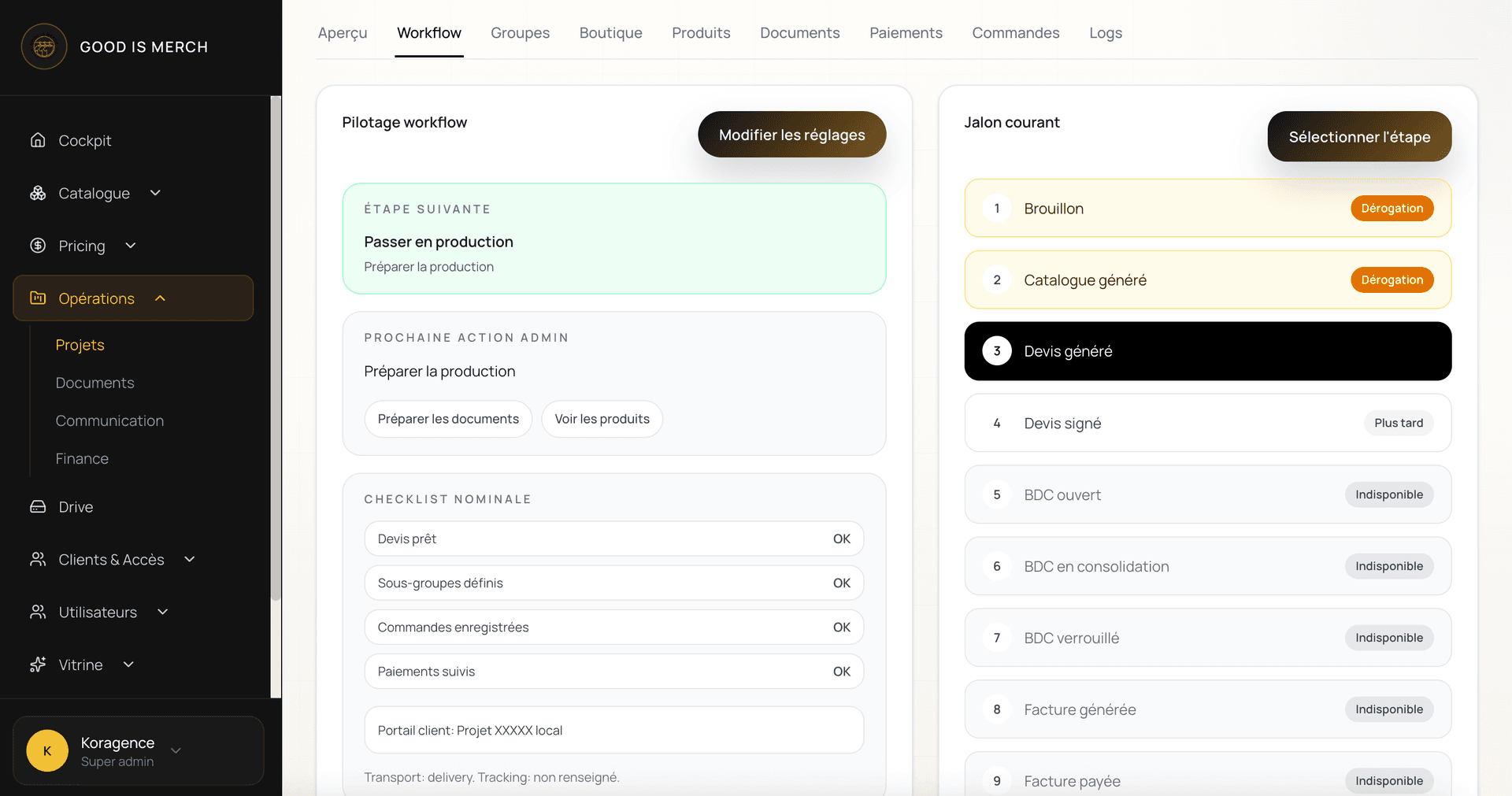
 Good is Merch